Utilities, libraries, benchmarks and research projects, past and present. Some are current; many are older and kept here for reference. Our main products are Process Lasso and ParkControl.
Keeps the processes you choose from being scheduled on efficient cores (E-cores), so they stay on performance cores (P-cores). This helps demanding applications such as games, audio production, video editing and streaming.
Continuously monitors running processes for resource anomalies: CPU spikes, memory bloat, handle leaks, thread bombs and more.
Real-time CPU optimization software containing Process Lasso’s ProBalance algorithm, which helps retain system responsiveness during high CPU loads.
Thread scheduling optimization for the AMD Threadripper 2990WX and 2970WX.
On Windows systems with more than one processor group (more than 64 logical CPU cores), lets processor group unaware applications use the entire CPU, by dynamically assigning active threads to additional processor groups as needed.
Controls disk device write cache policies. Shows a quick overview of each device’s write cache characteristics and toggles the Windows disk write caching policies.
Recursively excludes files and folders from the Windows Recent Files list (the lower pane in Explorer’s Home view). Windows otherwise only lets you hide specific files from Recent Items after the fact.
Calculate CPU affinity masks, and learn how to set a process’s CPU affinity permanently.
Moves a folder to another drive and replaces it with an NTFS junction point, so nothing that refers to the old path needs to change. Works on Windows 2000 to Windows 7; Windows Vista and later show these junctions with a shortcut overlay. Read the warnings and cautions on the product page before using it.
Manages NTFS reparse points, including creating junctions (virtual folders). Also called SHJunc.
InformationDownload 32-bitNo longer availableDownload 64-bitNo longer available
A small console utility that deletes or replaces files at system boot. It works with all Windows versions, even Windows 9x.
Compares your registry with an exported REG file. Compare part or all of your registry with another system or an earlier state to find likely causes of problems, and see exactly what a REG file will change before importing it selectively.
Intercepts and monitors NT device driver I/O request packets (IRPs). It can hook virtually any device on the system, show which processes interact with it, and dump the contents of the IRPs for analysis. It supports Windows NT kernels and was tested through Windows XP.
Adjusts the Win32PrioritySeparation registry value, which controls whether the foreground app (the one with focus) gets longer CPU time slices than background processes, and by how much. In Process Lasso, it’s under Options / Tools.
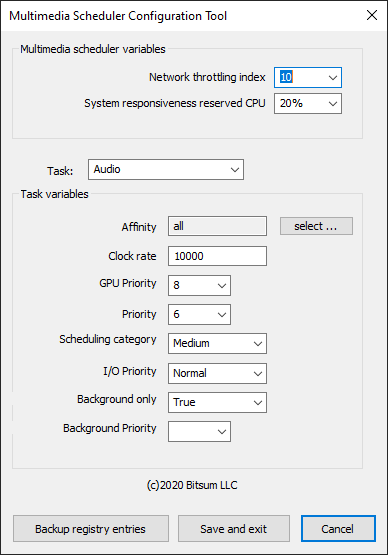
Configures the Multimedia Class Scheduler service in Windows Vista and later. Also called VistaMMSC.
A benchmark and stress test that places a load on specific logical cores, to measure the relative performance of individual CPU cores. It’s included with Process Lasso, in the Options / Tools menu.
A bursting-load CPU benchmark, most useful for comparing power plan settings.
Puts a load on all CPUs. It was created to test Process Lasso’s ProBalance, but it can test anything for its effect on overall system responsiveness. Its version follows Process Lasso’s.
Download 32-bitDownload 64-bit
The 64-bit build is for 64-bit Windows only.
Benchmarks the Windows registry, so you can see whether cleaning or defragmenting it makes a difference. It’s a console utility that writes XML, viewable in a web browser with the included display template.
One of the original Windows 32-bit executable compressors.
PE manipulation utilities formerly bundled with PECompact: PETrim, PESubsys, PEChksum, PEHideText, PEInsert, PESetVer, PEClassify and others. Most work on both 32-bit PE and 64-bit PE+ files. For a limited developer audience.
Bundles multiple files into a single executable, without extracting them to disk at runtime. It can also download bundled DLLs on demand and register COM controls.
Times how long executable compressors, bundlers and other wrappers take to decompress or reconstruct the host executable, by measuring from process creation until the instruction pointer reaches the original entry point.
View C++ sourceDownloadNo longer available
A compression library with an excellent compression ratio and very fast decompression with low memory overhead. Written in 32-bit x86 assembly, with a DLL and libraries for use in your own projects. Its compression ratio is generally better than Zip’s Deflate, though compression is slow. Used by PECompact (pec2codec_jcalg1.dll) and many other applications, including by AMD for BIOS compression and VMware for application virtualization. No longer maintained, but fully functional.
A very simple implementation of the LZSS compression algorithm in C++. Written decades ago and not meant for real-world use, but a good example.
Scans assembly language projects for unreferenced variables, a feature missing from most assemblers.
DownloadNo longer available
Two C++ classes, bitin and bitout, for input and output at the bit level. Useful for compression, encryption and any other code that works on bits.
A string search implementation with x86 assembly source and a DLL, including binary, case sensitive and case insensitive searches. The search table is rebuilt on each search, so it isn’t ideal for repeated searches for the same substring.
x86 assemblyNo longer availableC++
Extracts, modifies and rebuilds firmware images for many popular embedded devices. It was created for DD-WRT firmware images for the WRT54G, WRT54GL and WRT54GS.
We analyzed and documented the proprietary firmware image format and its checksum algorithm, and wrote open source utilities to extract and build compatible images for the WRT54G and WRT54GS v5-v6. This allowed third-party Linux firmware to be flashed on them for the first time, and it made news. We also published modified CFE boot loaders that allow extended overclocking by patching the clock frequency table.
Deconstructs, builds, fixes and analyzes VxWorks firmware images for the WRT54G v5, WRT54G v6, WRT54GS v5 and similar models, with reverse engineered data structure definitions and the required checksum algorithm.
Download v0.94b with sourceNo longer availableDocs and research
Splits TRX firmware images into their component parts.
We found the serial port on the PCB, documented the firmware file format and wrote utilities to work with it.
We found the serial port on the PCB, documented the firmware file format and wrote utilities to work with it.
The structure of an IPK package and a script to create one. IPKs are used by OpenWrt-based firmware and relatives like DD-WRT.
A web interface for OpenWrt, founded as a community project. After many hundreds of hours of contributions to get it off its feet, we turned it over to the community for further development.
The project’s website is no longer online.
No longer available.
Tools for PC technicians and developers who needed to replace files protected by Windows File Protection. It’s likely none of their mechanisms work on modern Windows.
No longer available.
Showed the characters behind the asterisks in password fields of many applications, the same way a browser’s “show password” link does.
No longer available.
Each project is licensed separately and may have unique terms. For licensing questions, please contact us.