
 ParkControlFree for Windows, by Bitsum
Tune core parking, frequency scaling and P/E-core scheduling for every power plan. No registry edits, no reboot.
A beta is available. Try the beta
 1
2
3
1
2
3
What it does
Windows parks cores aggressively, even in High Performance. Waking them adds latency every time a game, a DAW or a call bursts the CPU. ParkControl puts those settings in front of you.
Turn parking off for a responsive plan, keep the Windows default, or park aggressively to save power.
Minimum unparked cores, 0 to 100%
Set the lowest clock each plan may drop to, separately for plugged-in and battery power.
Minimum processor state, AC and DC
Decide whether short and long running threads go to P-cores, E-cores, or wherever Windows prefers.
Intel 12th gen and newer, Core Ultra
Switch to a fast plan while you work and a frugal one when the PC sits idle. Automatic.
Plus power plan change notifications
ParkControl Pro
Lifetime licenses are a one-time payment and include every future update. No subscription.
| Feature | Free | Pro |
|---|---|---|
| Core parking and frequency scaling | ✓ | ✓ |
| Hybrid thread scheduling | ✓ | ✓ |
| Live core map in the tray | ✓ | ✓ |
| Dynamic Boost | – | ✓ |
| Power plan change notifications | – | ✓ |
| Funds independent development | – | ✓ |
One PC. Pay once, keep every future update.
Up to 5 PCs in one home, non-commercial use.
30-day money-back guarantee on every plan.
Downloads
Most PCs need x86-64. Use ARM64 only on Windows on ARM devices such as Snapdragon laptops. Click a checksum to copy the full SHA-256.
Reference
Guide
CPU Parking is a low-power sleep state (C6) supported by most modern processors and operating systems. It dynamically disables CPU cores in an effort to conserve power when idle. Unfortunately, this power saving comes at a price: Latency when CPUs need to be unparked to execute code.
Initially, core parking was controlled entirely by the operating system. The aggressive core parking of Windows led to a great deal of inefficiency during bursting CPU loads. Intel moved core parking control onto the chip in the Skylake generation, and AMD followed, but still the parameters of the Windows power plans are set to aggressively park CPU cores. Even the default ‘High Performance’ power plan is not immune. The new ‘Ultra Performance’ power plan copies what Bitsum did with our own ‘Bitsum Highest Performance’ power plan and finally disables core parking entirely.
ParkControl (and Process Lasso) not only let one more easily configure CPU core parking and frequency scaling, but also allow for dynamic entrance into a higher performance power plan. For instance, with Process Lasso, you can automatically enter ‘Bitsum Highest Performance’ when you start a game, then go back to ‘Balanced’ when you exit.
ParkControl has Dynamic Boost to allow you to set active and idle power plans. Process Lasso has a similar feature with its IdleSaver.
Empirical evidence shows that disabling CPU core parking can make a tangible improvement in system performance. There are many factors that will determine precisely how effective it will be for a given situation. However, generally, Windows is too aggressive in its core parking, resulting in high latency during bursting CPU loads, stemming from the overhead of having to unpark CPU cores. Since bursting CPU loads are the most common type for many workloads, core parking can be a substantial drag on system performance and responsiveness.
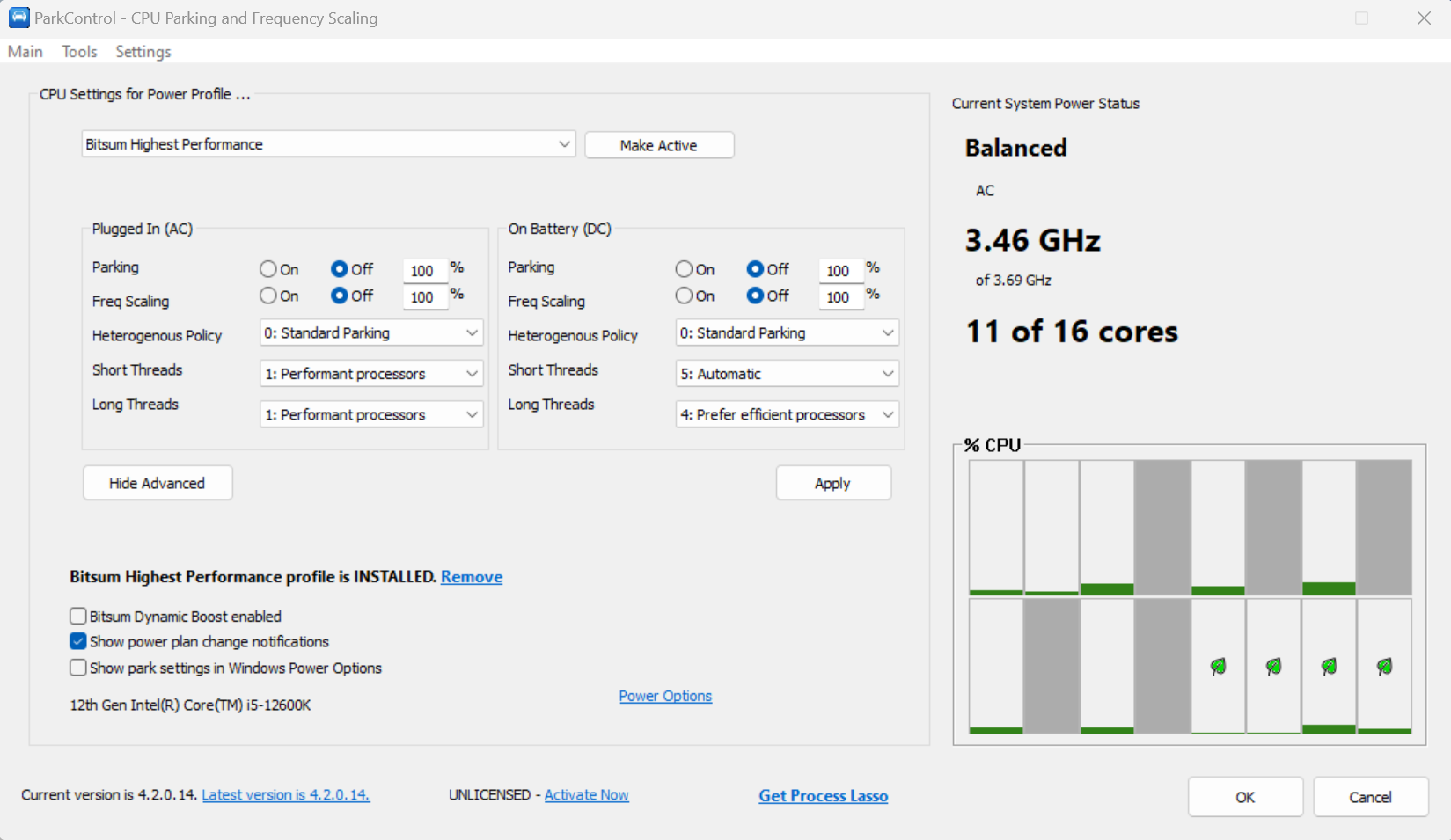
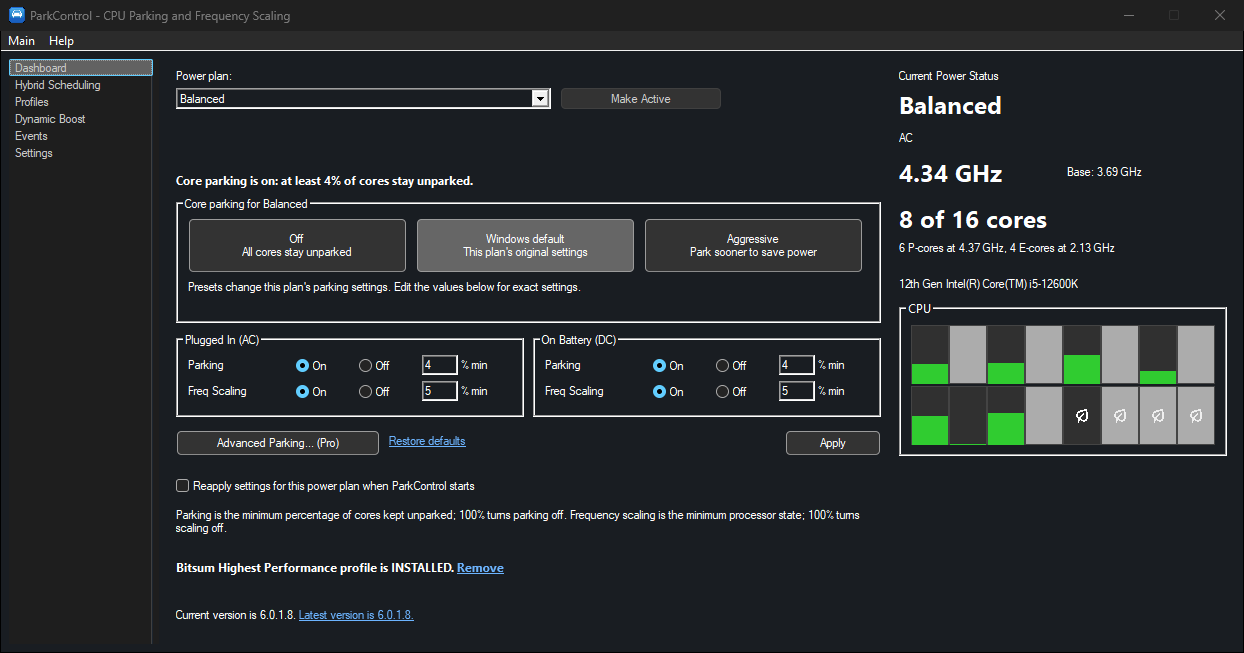
ParkControl lets you easily set CPU core parking and frequency scaling parameters for both AC (plugged-in) and DC (battery) power states of your device.
Both CPU core parking and frequency scaling are power saving features of modern CPUs. CPU core parking is when cores are put into a sleep-like state when demand is low. Similarly, CPU frequency scaling allows the CPU base frequency to be lowered, again to conserve energy.
Each power plan has its own settings, and can be selected via the power plan drop-down. When you select a power plan, the user interface will populate with that power plan’s settings. After making changes, click the ‘Apply’ button to save them. Use the ‘Make Active’ button to switch the PC to that power plan.
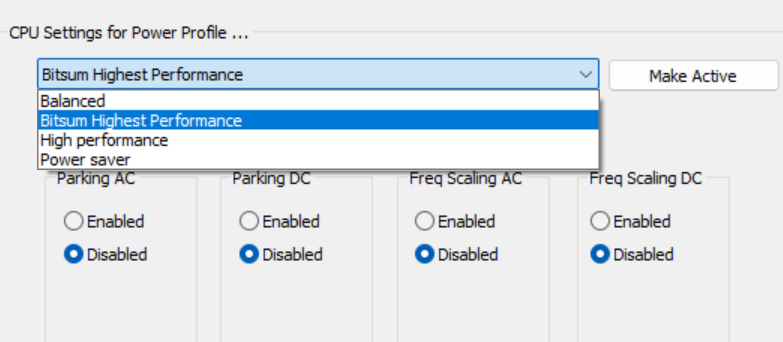
Any changes you make with ParkControl are easily reverted. To restore defaults of a power plan, simply click the ‘Restore defaults’ link shown on the user interface. You can select each stock power plan (or overlay) to restore the defaults of it.
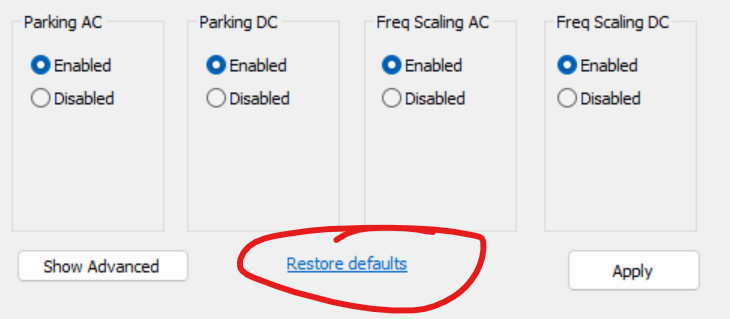
Non-stock power plans such as Bitsum Highest Performance can be restored to default by deleting and recreating them.
Instead of using ParkControl, you can change power settings from the Windows command line interface via Powercfg.exe. You must run this utility with elevated rights, so be sure to open an elevated console window by right-clicking ‘cmd.exe’ and selecting ‘Run as Administrator’.
Note that these commands adjust the currently active power plan, as indicated by SCHEME_CURRENT.
First, backup ALL your Power Settings by creating a dump of everything to a TXT file. It is unlikely you will ever need this, but…
powercfg /qh > powerconfig.txt
We’ll be reconfiguring the power plan attribute CPMINCORES (0cc5b647-c1df-4637-891a-dec35c318583).
To mandate 50% of available cores always remain unparked, run:
powercfg /setacvalueindex SCHEME_CURRENT SUB_PROCESSOR CPMINCORES 50
To adjust it so that only 25% of available cores remain active at all times, allowing 75% of available cores to be parked, you’d run:
powercfg /setacvalueindex SCHEME_CURRENT SUB_PROCESSOR CPMINCORES 25
‘0’ <zero> indicates to park as many CPU cores as possible.
To enable maximum use of CPU Parking for the power profile you are currently using:
powercfg /setacvalueindex SCHEME_CURRENT SUB_PROCESSOR CPMINCORES 0
To disable CPU Parking completely for the power profile you are currently using, you’d want to run:
powercfg /setacvalueindex SCHEME_CURRENT SUB_PROCESSOR CPMINCORES 100
All the above configure core parking while the system is plugged into AC power. For DC (battery) power, core parking is usually forced, but to configure it you would instead use ‘-setdcvalueindex’.
After changing the power scheme settings for CPU Parking as desired, you then want to make the changes active by running the command:
powercfg /setactive SCHEME_CURRENT
With ParkControl, a reboot is NOT required for these changes to take effect – in contrast to direct registry edits or other core parking software.
After applying tweaks, check the Windows Resource Monitor (resmon.exe) and verify that CPU Parking is indeed as you intend.
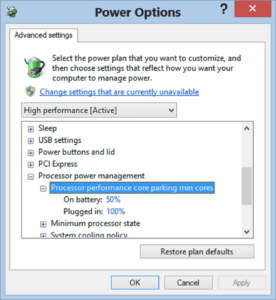
To show the core parking settings in the Windows Power Options, you can simply use the checkbox ‘Show park settings in Windows Power Options’ on the ParkControl window. However, if you want to do it yourself, use these commands.
Show Core Parking Settings:
powercfg /attributes SUB_PROCESSOR CPMINCORES -ATTRIB_HIDE
Hide Core Parking Settings:
powercfg /attributes SUB_PROCESSOR CPMINCORES +ATTRIB_HIDE
FAQ
ParkControl offers features that Process Lasso does not, so it makes a good complement to Process Lasso, and the two products will run alongside each other fine.
Some of the unique features that ParkControl offers are:
If only you see ‘overlays’ and no Bitsum Highest Performance (BHP) power plan, that means your system is using Power Modes in lieu of traditional power plans. In this case, the BHP power plan is not necessary and ‘Maximum Performance’ should be used instead. If you want to tweak that power plan, you can use ParkControl to do so!
Some systems have power configurations that are locked down by the OEM.
Try using menu item “Settings > Experimental > Always Show Bitsum Highest Performance“, then select that (BHP) power profile.
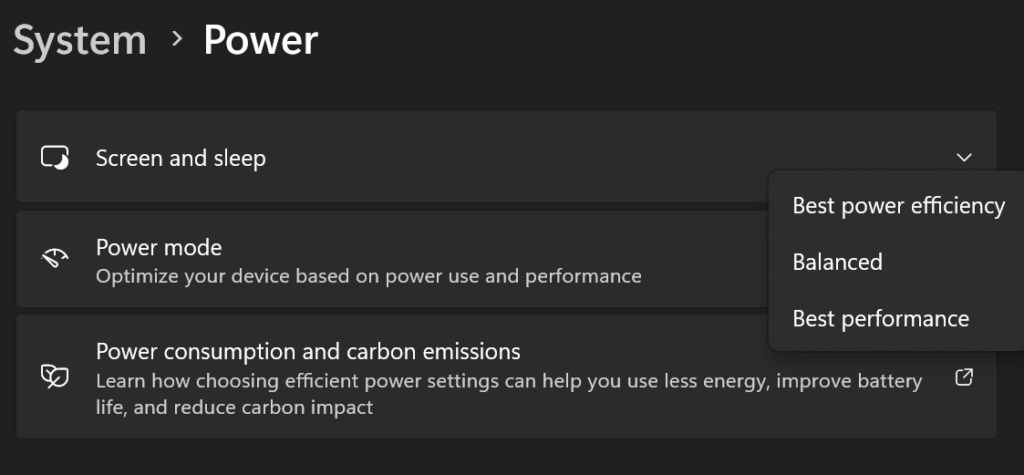
Users can switch to Power Modes (overlays) by entering the ‘Balanced’ power plan, then opening the System Power settings and selecting one of the three Power Modes, as shown below. Alternatively, the battery icon in the tray can be used to select a Power Mode. After doing this, restart ParkControl for them to show up.
See this post for more information.
When your PC goes Idle, Dynamic Boost switches to ‘Power Saver‘. If you do not want your PC to sleep, you need to change that setting for the Power Saver power plan. To do this, open ‘Power Options‘, find ‘Power Saver‘, and edit it. You can also switch to it, then change the sleep settings in their separate config area in Windows.
CPU core parking and frequency scaling can have a dramatic impact on real-time performance of bursting loads like audio/video, gaming, VOIP, and more. That is a big reason we have made such a ‘fuss’ over them. It was nice to be ‘vindicated’ by Intel, who has moved core parking control to the hardware in new CPU generations because the OS’s management was so sub-optimal. As long as they retain the ability to disable core parking, and I’m sure they will, it should be a good change. Microsoft seemed to focus entirely on battery life in recent years, leaving performance to suffer, particularly for desktop users.
No, direct registry edits are not advisable. ParkControl makes these changes the correct way. The storage of the settings is backed in the registry, but why would you go hacking around in there when you can make these changes the right way and not risk damage? ParkControl’s changes to the system power plans are persistent, they don’t go away.
First, if you never saw your CPU cores park, then it may be that your system just doesn’t support core parking. If you have seen your cores park in the past, but aren’t seeing parking activity, double check with the Task Manager or Resource Monitor (resmon.exe) to make sure it is not just a display error in the ParkControl GUI.
ParkControl changes settings of the Windows power plans based on your selections. These changes persist even if ParkControl is not running or uninstalled. For system defined power plans, you can reset to defaults in the Windows Power Options (linked to from the ParkControl GUI).
First, ensure that you are using the right activation code. You can use any name. Do not confuse the ‘purchase key’ on the invoice with the activation code. They are the same format.
Otherwise, failure could be caused by a temporary network problem, or prior use of a pirated copy of our software that modified your system HOSTS file, preventing resolution of our servers.
Try installing Process Lasso from https://bitsum.com/. It will alert you if the HOSTS file was modified. If you don’t see a warning, then it wasn’t the cause. You can later uninstall Process Lasso.
Guidance also here: https://bitsum.com/activation-help/
If it continues to fail, contact us and we’ll refund your purchase.
ParkControl is normally used to disable core parking to achieve a performance boost, not enable it. Enabling core parking can cause performance problems with some CPUs, depending on how aggressive the parameters are. That said, yes, you can save energy by enabling core parking, but we recommend only doing that in select power plans, such as Power Saver.
You will be prevented from doing this because the two features serve the same purpose and would conflict. You should use one feature or the other.
AC = When your device is plugged in.
DC = When your device is using its battery.
From version 6.0, ParkControl shows the same effective speed as Task Manager’s Speed. It is read from Windows performance counters once a second, so turbo boost and throttling show up. Busy cores count more than idle ones, so idle cores don’t drag the number down. The smaller line underneath is the CPU’s base speed, and on hybrid CPUs the P-cores and E-cores get their own speeds.
If it still reads lower than you expect:
Version 5.x and earlier showed the average base (non-boosted) clock, so turbo speeds did not appear.
No. On applicable AMD processors, disabling core parking in the power plans or modes does not impact the whole CCD “parking” as found in Ryzen Master, or impede scheduling decisions regarding preferred CCDs.
The whole CCD “parking” is a separate concept from individual core parking, and it can’t be controlled by ParkControl. We recommend using Process Lasso to direct apps and games to specific CCDs.
NOTE: To reduce update notifications, minor updates may not be pushed to all existing installations. You can always initiate an update check manually to override this.
… older history clipped.
Need more control?
ProBalance keeps background processes in check, plus persistent priorities and CPU affinities, and power plans that switch per app.